

Secure Email vs Regular Email: What Businesses Need to Know
March 2, 2026
Why Regulatory Compliance Matters for Enterprise Email Security
March 16, 2026
How Agentic AI Will Transform SaaS Products in the Next 5 Years
March 9, 2026
Artificial intelligence is reshaping how software platforms work. Over the last few years, Generative AI has helped SaaS companies introduce features that can create content, summarize information, and assist users in completing everyday tasks. Many SaaS tools now integrate AI to improve productivity and simplify workflows.
However, the next stage of AI innovation is already emerging. This shift is driven by Agentic AI, a technology designed to move beyond simple assistance and toward autonomous action. Instead of waiting for user prompts, these AI systems can analyze goals, plan actions, and execute complex tasks independently.
For SaaS platforms, this development represents a major transformation. In the next five years, software products will increasingly rely on intelligent AI agents that manage workflows, automate processes, and support real-time decision-making. As businesses adopt these technologies, SaaS platforms will evolve from static tools into intelligent systems capable of actively improving productivity and workplace communication across organizations.
The Evolution of AI in SaaS Platforms
SaaS platforms have experienced significant technological evolution over the past decade. Initially, these tools were designed to digitize business processes such as email communication, document management, and team collaboration. While this shift improved accessibility and efficiency, most platforms still required significant manual input from users.
The introduction of automation brought the next wave of innovation. SaaS companies began integrating automation features that could reduce repetitive tasks and streamline operational workflows. Businesses could now automate data entry, notifications, and simple processes, which saved time and improved productivity.
More recently, Generative AI expanded the capabilities of SaaS platforms even further. AI models can now create content, summarize conversations, and assist users with writing emails or reports. These features also improve workplace communication by enabling faster and more efficient interactions between teams.
Despite these advancements, most AI-powered tools still rely on user instructions. Agentic AI introduces a more advanced model where software systems actively manage tasks rather than simply responding to prompts.

What Is Agentic AI?
Agentic AI refers to autonomous artificial intelligence systems that can plan, make decisions, and execute multi-step tasks with minimal human involvement. These systems function as intelligent agents capable of understanding objectives and determining how to achieve them effectively.
Unlike traditional automation systems that follow predefined rules, Agentic AI systems can evaluate situations dynamically. They analyze data, adjust strategies, and adapt their behavior based on changing circumstances. This ability makes them highly valuable for complex workflows that require continuous decision-making.
For instance, an AI agent integrated within an enterprise email solution could automatically organize incoming messages, identify priority emails, draft responses, and schedule follow-up actions. Instead of manually managing these tasks, users would rely on the AI system to handle the process intelligently.
Key characteristics of Agentic AI include:
- Goal-driven actions – AI works toward achieving specific outcomes
- Autonomous decision-making – minimal human involvement
- Multi-step task execution – completes complex workflows
- Continuous learning – improves performance over time
These capabilities allow SaaS platforms to shift from reactive tools to proactive systems that actively assist users in achieving business goals.

Agentic AI vs Generative AI
Generative AI and Agentic AI represent two different approaches to using artificial intelligence within software systems. While both technologies rely on advanced machine learning models, their purposes and capabilities differ significantly.
Generative AI focuses primarily on creating content based on user prompts. It is commonly used for generating text, images, summaries, or recommendations. Many SaaS platforms already use Generative AI to help users draft emails, create reports, or produce marketing content.
Agentic AI goes beyond content creation. Instead of simply generating outputs, it focuses on executing tasks and managing workflows autonomously. These AI systems can analyze situations, make decisions, and perform multiple actions to achieve a defined objective.
For example, features such as AI Compose allow users to quickly generate email drafts or suggested responses. This improves productivity by reducing the time needed to write messages. However, users still need to review and send the content manually.
Agentic AI systems would take this process further by analyzing the context of conversations, generating appropriate responses, and delivering them automatically when required.
|
Feature |
Generative AI |
Agentic AI |
|
Primary Role |
Content generation |
Task execution |
|
Interaction Style |
Prompt-based |
Goal-based |
|
Automation Level |
Moderate |
High |
|
Example |
Writing emails or reports |
Managing workflows automatically |
Understanding this difference helps businesses evaluate how AI technologies can support their long-term digital transformation strategies.

Why SaaS Products Are Moving Toward Agentic AI
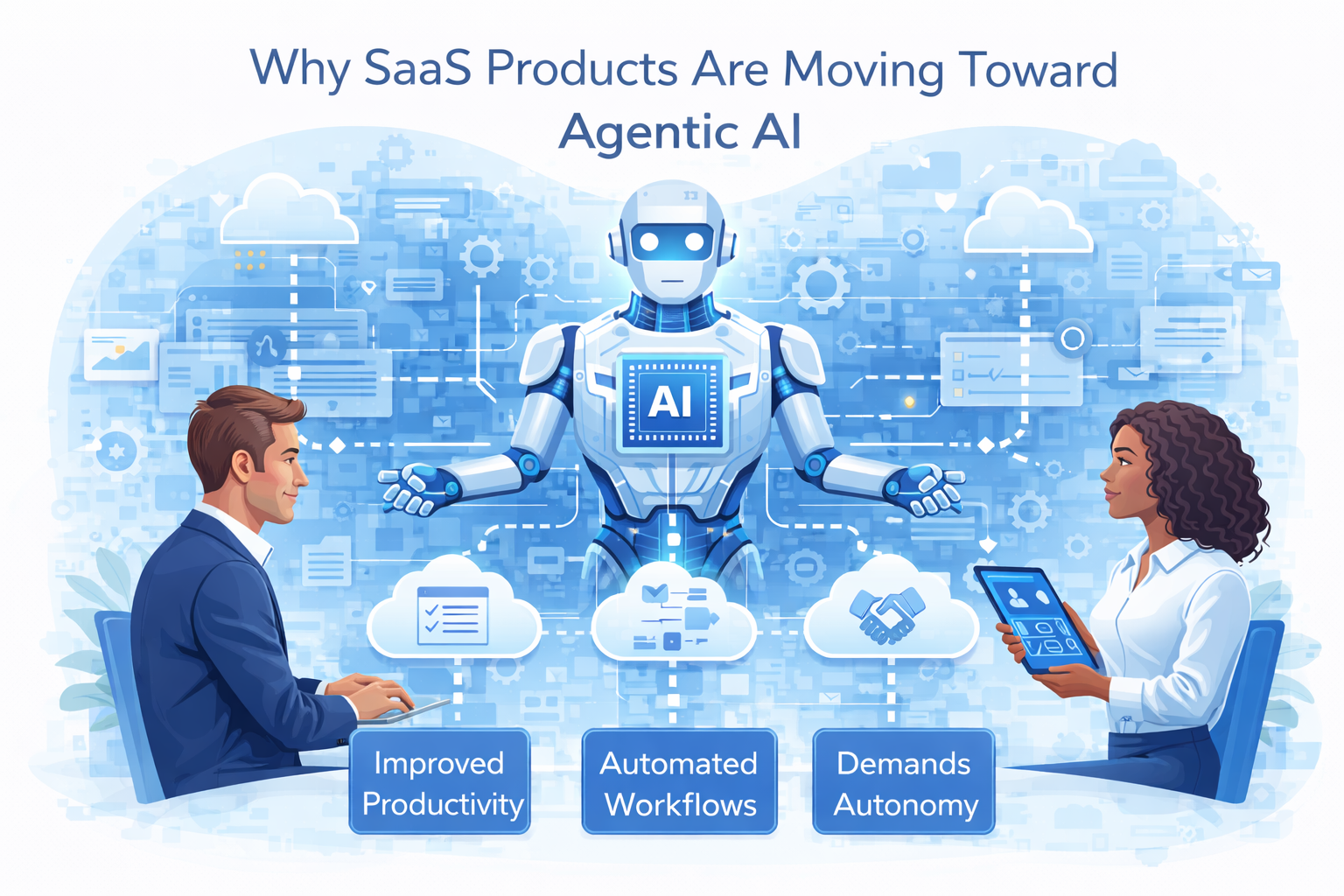
Businesses today operate in highly dynamic and competitive environments. Organizations must process large volumes of data, manage complex workflows, and respond quickly to changing market conditions. As a result, companies increasingly expect software platforms to provide intelligent automation rather than simple tools.
Agentic AI helps meet this demand by enabling SaaS platforms to perform tasks autonomously. Instead of requiring constant user supervision, these systems can independently manage processes, analyze outcomes, and optimize workflows. This capability significantly reduces the operational burden on teams.
Another important factor is the growing need to improve collaboration and workplace communication. As organizations adopt remote and hybrid work models, they require tools that can support efficient communication while minimizing manual effort.
Several key drivers are accelerating the adoption of Agentic AI in SaaS platforms:
- Growing need for intelligent automation
- Increasing data complexity
- Demand for faster decision-making
- Need to improve workplace communication and collaboration
By integrating AI agents into their products, SaaS companies can deliver smarter solutions that help businesses operate more efficiently.
5 Ways Agentic AI Will Transform SaaS Products
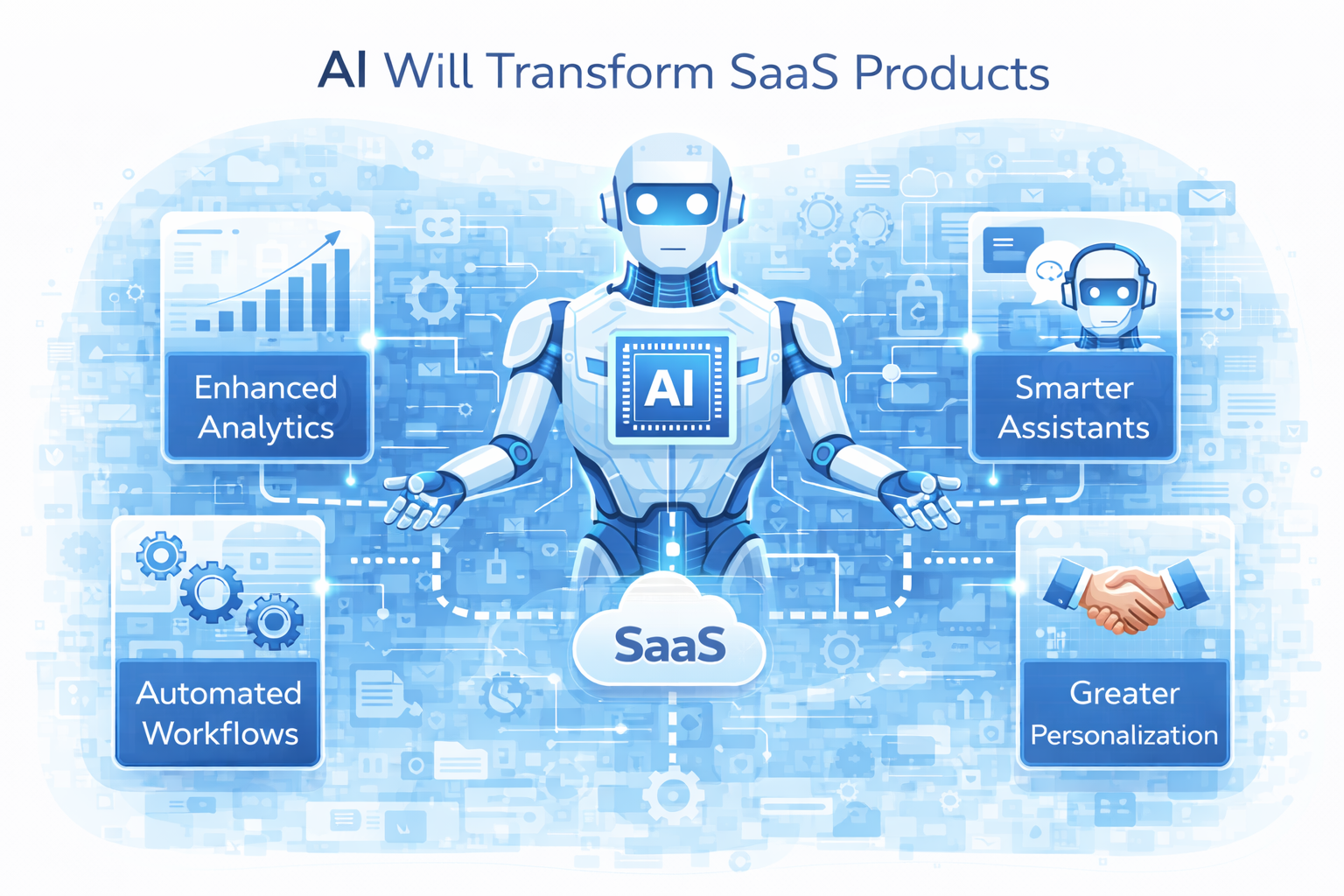
Agentic AI will introduce major changes in how SaaS platforms function. Instead of acting as passive software tools, these platforms will become intelligent systems capable of managing business processes and optimizing workflows automatically.
The following transformations are likely to shape the SaaS industry in the coming years.
1. Autonomous Workflow Automation
Automation has always been a core value proposition for SaaS platforms. However, traditional automation systems rely on predefined rules and limited conditions. When workflows become more complex, these systems often require human intervention to manage exceptions or unexpected situations.
Agentic AI introduces a more advanced form of automation that can handle dynamic scenarios. AI agents can analyze incoming data, understand context, and execute multiple steps required to complete a task. This allows businesses to automate workflows that were previously too complex for rule-based systems.
For example, AI agents integrated into communication or productivity platforms could automatically process information, prioritize tasks, and coordinate activities across teams. In an intelligent enterprise email solution, an AI agent could classify messages, draft responses, and ensure important emails receive immediate attention.
Examples of automated workflows include:
- qualify sales leads
- schedule meetings
- respond to customer inquiries
- update CRM records
- manage project tasks
Such capabilities allow businesses to significantly reduce manual work and improve operational efficiency.
2. Self-Optimizing SaaS Platforms
Another powerful capability of Agentic AI is its ability to continuously learn and improve system performance. Traditional software platforms require manual updates or configuration changes when workflows need optimization. Agentic AI systems can automatically detect inefficiencies and adjust their behavior accordingly.
These systems analyze user behavior, application performance, and workflow outcomes to identify opportunities for improvement. Over time, they refine their strategies to deliver better results without requiring constant human oversight.
For SaaS providers, this means platforms will become more intelligent and adaptive. Instead of remaining static, the software will evolve based on real-world usage patterns.
Examples include:
- detecting inefficiencies in processes
- recommending workflow improvements
- adjusting system configurations
- improving user experiences
This capability enables SaaS platforms to provide continuous optimization that helps businesses operate more effectively.
3. Intelligent Customer Support
Customer support operations are another area where Agentic AI can deliver significant value. Many SaaS companies currently rely on chatbots or automated response systems to manage customer inquiries. While these tools can handle basic requests, they often struggle with complex issues.
Agentic AI enables support systems to operate more intelligently. AI agents can analyze customer messages, understand context, access relevant data, and determine the best solution to a problem. These systems can also learn from previous interactions to improve their responses over time.
As a result, support platforms can handle a wider range of requests without human intervention. When issues require expert assistance, the AI system can automatically escalate them to the appropriate support team.
AI-powered support agents can:
- understand customer intent
- analyze support history
- resolve issues automatically
- escalate complex cases to human agents
This approach improves response times while reducing the workload for customer support teams.
4. Predictive Decision-Making
Modern businesses rely heavily on data to guide decision-making. However, analyzing large datasets manually can be time-consuming and challenging. Agentic AI systems can process vast amounts of information quickly and identify patterns that humans might overlook.
By leveraging predictive analytics, AI agents can forecast potential outcomes and recommend actions to achieve desired results. This capability allows SaaS platforms to move beyond simple reporting and provide proactive business insights.
For example, AI agents within a SaaS platform could analyze user behavior, market trends, and operational data to predict opportunities or risks. Businesses can then use these insights to make better strategic decisions.
Agentic AI systems can:
- forecast sales opportunities
- predict customer churn
- recommend business actions
- identify operational risks
This predictive capability enables organizations to shift from reactive problem-solving to proactive planning.
5. Hyper-Personalized User Experiences
Personalization has become a key factor in modern software design. Users expect SaaS platforms to adapt to their needs and preferences rather than forcing them to follow rigid workflows.
Agentic AI enables deep personalization by continuously analyzing how users interact with the platform. Based on this information, the system can customize dashboards, automate routine tasks, and deliver recommendations tailored to individual users.
Features like AI Compose already help users create messages and responses faster. These tools reduce the time required to communicate and improve overall efficiency.
In the future, AI agents will expand these capabilities by understanding communication patterns and generating highly relevant suggestions for each user.
Examples include:
- personalized dashboards
- intelligent recommendations
- adaptive workflows
- automated content generation
These improvements will significantly enhance productivity and user satisfaction.
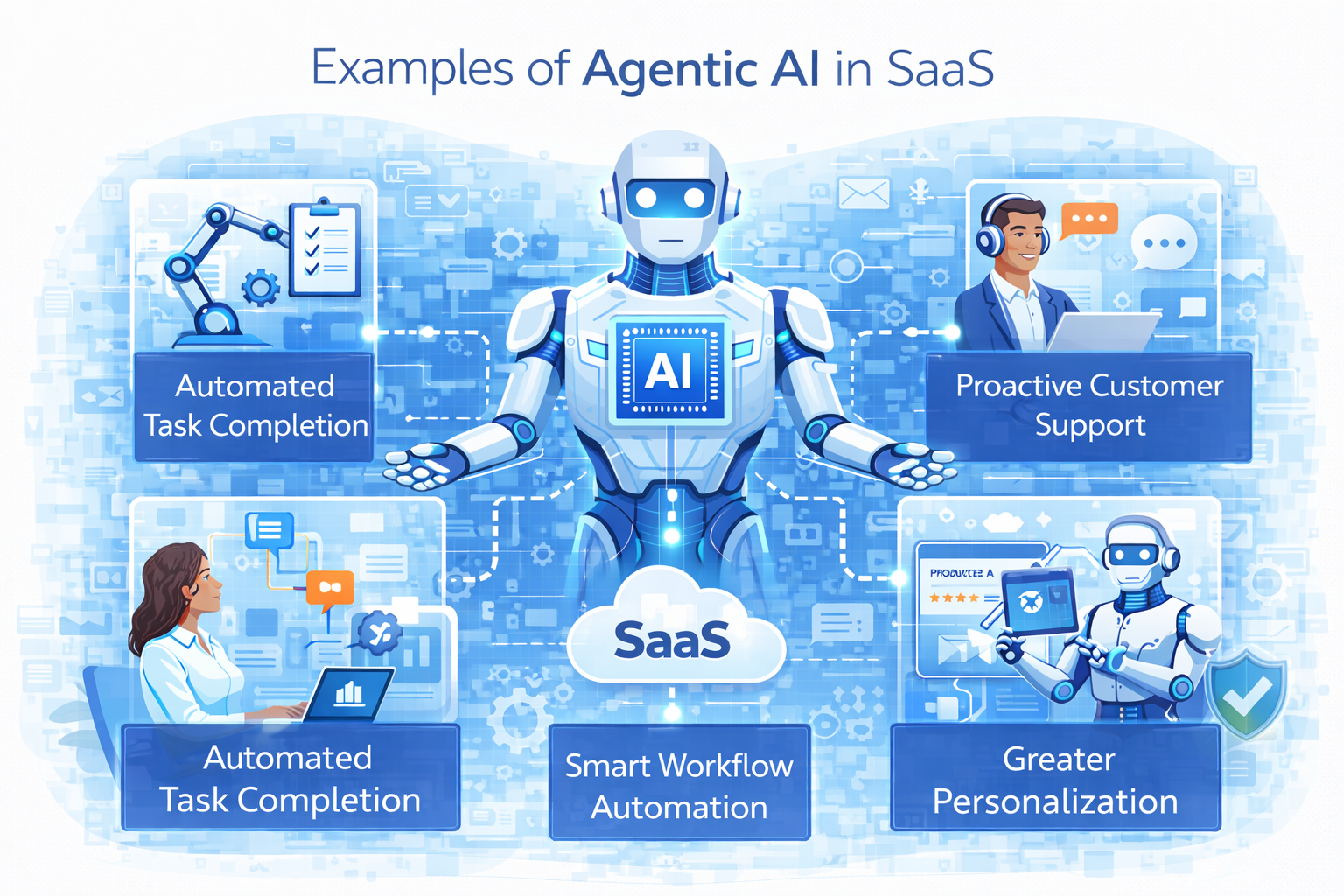
Real-World Examples of Agentic AI in SaaS
Although Agentic AI is still evolving, several SaaS platforms have already started integrating AI agents into their systems. These early implementations demonstrate the potential impact of autonomous AI systems in business software.
Many organizations are experimenting with AI-powered tools that can analyze workflows, automate decisions, and manage complex operations. These solutions show how Agentic AI can improve productivity and operational efficiency across multiple industries.
Examples include:
AI Sales Assistants
- automatically qualify leads
- analyze customer interactions
- recommend follow-up actions
AI Marketing Automation Tools
- generate campaign strategies
- optimize ad performance
- personalize content
AI DevOps Agents
- monitor system performance
- detect anomalies
- resolve infrastructure issues
AI Communication Platforms
- generate responses
- organize conversations
- improve workplace communication efficiency
These use cases highlight how AI agents are beginning to transform SaaS platforms into intelligent digital assistants.
Challenges of Agentic AI in SaaS
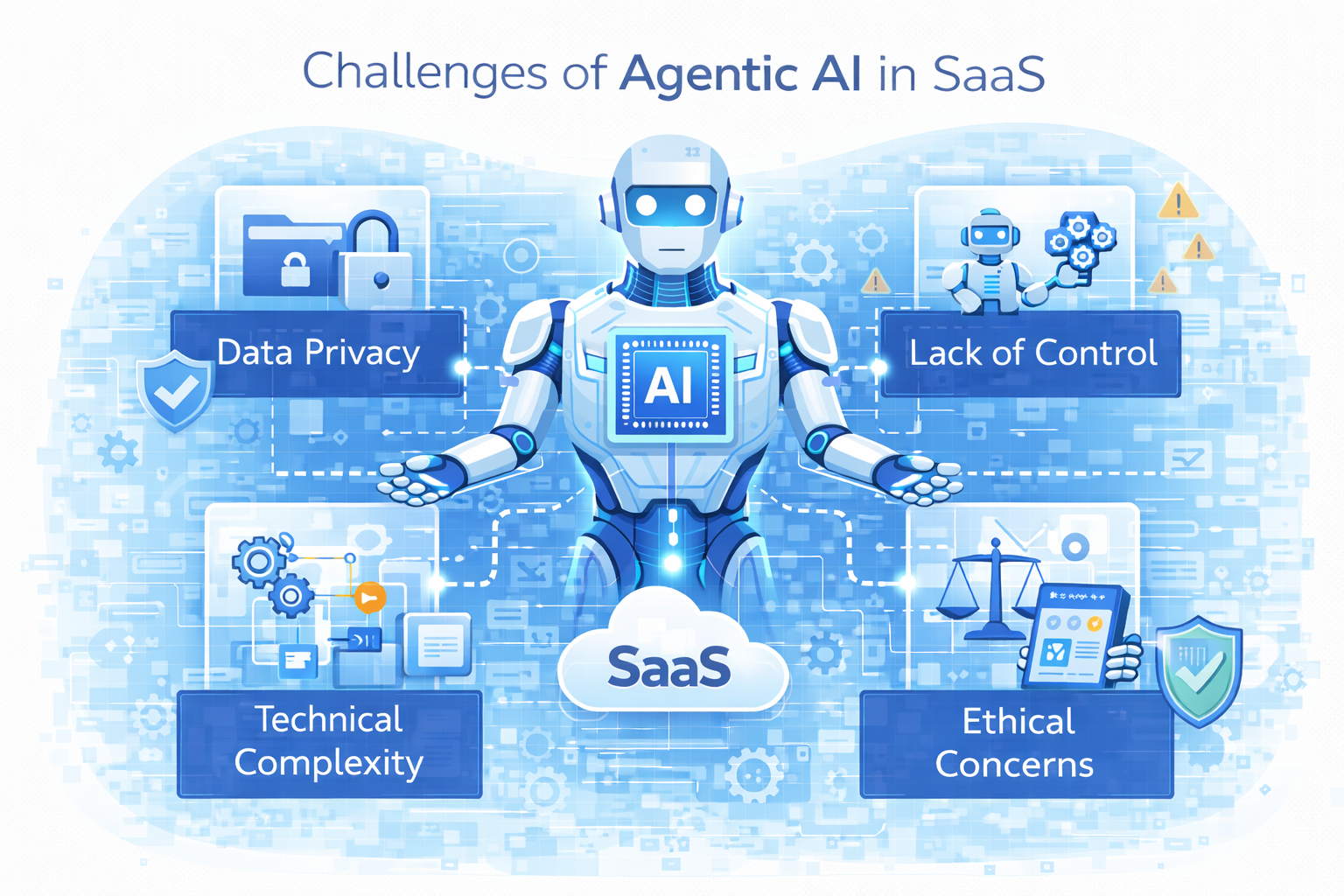
Despite its promising capabilities, Agentic AI also introduces several challenges that SaaS providers must address. Autonomous systems require careful design, strong governance, and robust security measures to ensure safe operation.
One major concern involves data security and privacy. AI agents often need access to sensitive business data to perform their tasks effectively. Organizations must ensure that these systems follow strict security protocols to prevent data misuse or unauthorized access.
Another challenge is maintaining transparency and accountability. When AI systems make autonomous decisions, businesses must understand how those decisions are made and ensure they align with organizational policies.
Key challenges include:
- Security risks related to automated decision-making
- Data privacy concerns when handling sensitive information
- Governance issues around AI accountability
- Reliability challenges in autonomous systems
Addressing these issues will be essential for ensuring responsible adoption of Agentic AI in SaaS platforms.
The Future of SaaS With Agentic AI
The SaaS industry is entering a new phase of innovation driven by autonomous AI systems. Over the next five years, Agentic AI will transform software platforms from passive tools into proactive assistants capable of managing complex workflows.
Instead of interacting with software through manual commands, users will define goals and rely on AI agents to execute tasks. These intelligent systems will coordinate processes, analyze results, and continuously optimize operations.
Future SaaS platforms are likely to include:
- autonomous AI assistants
- intelligent workflow automation
- predictive decision-making tools
- personalized user experiences
Organizations that adopt Agentic AI early will gain a significant advantage by improving efficiency, reducing operational costs, and enabling smarter decision-making.
Final Thoughts
Agentic AI represents the next major step in the evolution of SaaS platforms. While Generative AI introduced powerful tools for content creation and productivity, Agentic AI enables software systems to act independently and manage complex workflows.
As SaaS providers integrate AI agents into their platforms, businesses will benefit from greater automation, smarter insights, and improved collaboration. These advancements will help organizations enhance productivity and strengthen workplace communication across teams.
In the coming years, SaaS platforms will become more than software tools. They will evolve into intelligent systems that actively help businesses achieve their goals.