Introduction
Every cybersecurity training says the same thing: Don't click suspicious links. Don't open unknown attachments. Watch out for malware. Sound advice — but here is the uncomfortable truth: one of the most financially devastating cyberattacks in the world needs none of that. No malicious link. No infected attachment. No virus. Just a professional-looking email that lands in your inbox — and one moment of misplaced trust.
That is Business Email Compromise (BEC). And in 2025 alone, it grew by 60% in just two months (January–February). Every business that relies on email for professional communication is a potential target.
What Is Business Email Compromise (BEC)?
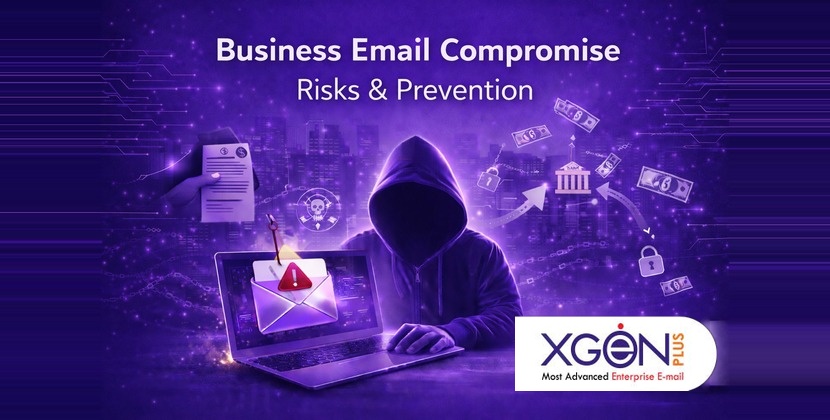
Business Email Compromise (BEC) is a targeted social engineering attack conducted via email, where cybercriminals impersonate trusted figures — executives, vendors, attorneys, or colleagues — to trick employees into transferring funds or disclosing sensitive information.
Unlike traditional phishing attacks, BEC:
- Contains no malware, no malicious links, no suspicious attachments
- Is highly targeted and low-volume (crafted for a specific person or organization)
- Exploits human trust and authority, not software vulnerabilities
- Bypasses traditional Secure Email Gateways (SEGs) because there is nothing technically malicious to detect
The FBI's Internet Crime Complaint Center (IC3) has classified BEC as "one of the most financially damaging online crimes", with cumulative global losses exceeding $55 billion over the past decade.
Why BEC Is More Dangerous Than Regular Phishing
Most employees have learned to identify generic phishing emails. BEC attackers know this — and deliberately avoid every traditional red flag.
|
Feature |
Phishing |
Business Email Compromise |
|
Volume |
Mass (thousands of recipients) |
Targeted (specific individuals) |
|
Malicious content |
Links, attachments, malware |
None — plain professional text |
|
Source |
Unknown or suspicious domains |
Spoofed or compromised real accounts |
|
Personalization |
Generic |
Highly specific to the target |
|
Detection by SEG |
Often caught |
Frequently bypassed |
|
Goal |
Credential theft / malware infection |
Wire transfer fraud / data theft |
This is why BEC emails often pass DMARC checks, look like normal business correspondence, and fool even experienced professionals.
How Does a BEC Attack Work? (Step-by-Step)
Understanding the anatomy of a BEC attack is the first step toward prevention. Here is how a typical attack unfolds:
Stage 1 — Reconnaissance
The attacker studies the target organization using open-source intelligence (OSINT): LinkedIn profiles, company websites, press releases, SEC filings, and social media. They map out:
- Organizational hierarchy (who reports to whom)
- Finance and HR personnel names
- Existing vendor relationships
- Ongoing projects, deals, or payment schedules
Stage 2 — Identity Setup
The attacker either:
- Spoofs an email address — registering a lookalike domain (xgenp1us.com vs xgenplus.com)
- Compromises a real email account — through credential theft, phishing, or dark web-purchased passwords
- Manipulates the display name — so the sender appears to be a known contact even from an unknown address
Stage 3 — The Attack Email
A precisely timed, professionally written email is sent. Common requests include:
- Urgent wire transfer to a "new" vendor account
- Payment of an overdue invoice with updated bank details
- Purchase of gift cards for "employee rewards"
- Change in payroll direct deposit information
- Sharing employee W-2s, salary records, or PII
Stage 4 — Psychological Manipulation
BEC emails almost always deploy two powerful psychological triggers:
- Urgency — "This must be completed today before end of business"
- Secrecy — "Please keep this between us — it's commercially sensitive"
These triggers prevent the victim from pausing to verify the request with a colleague or supervisor.
Stage 5 — Fund Transfer and Laundering
Once the victim complies, funds are rapidly moved through overseas bank accounts, cryptocurrency exchanges, or money mules — making recovery extremely difficult. Only 25% of BEC insurance claims see any meaningful financial recovery.
Real BEC Email Example
Here is what a BEC email targeting a finance executive actually looks like:
From: rajesh.mehta@xgenp1us.com (note the "1" instead of "l")
To: priya.sharma@xgenplus.com
Subject: Urgent — Vendor Payment Required Today
Hi Priya,
I am currently in a board meeting and cannot take calls. We have a time-sensitive payment of ₹22,00,000 due to our logistics partner. Failure to pay today will trigger a contract penalty.
Please process this transfer to the account details below immediately. I will approve the documentation when I return.
Please do not loop in anyone else yet — this involves a confidential vendor negotiation.
Thanks,
Rajesh Mehta
CFO, XgenPlus
No links. No attachments. Professional tone. Familiar name. Urgency. Secrecy. This is exactly what BEC looks like — and why it works so effectively against employees who use email for professional communication every day.
6 Types of Business Email Compromise Attacks
1. CEO Fraud (Executive Impersonation)
The most common and damaging form of BEC. The attacker impersonates a C-suite executive — CEO, CFO, or Managing Director — and pressures finance or accounting employees into making unauthorized wire transfers. The emails often reference real internal projects to appear credible.
2. Vendor Email Compromise (VEC)
A sophisticated variant where attackers impersonate a trusted supplier or vendor and send fraudulent invoices with modified bank account details. VEC attacks rose 66% in the first half of 2024 alone, often targeting organizations in construction, retail, and manufacturing.
3. Payroll Diversion
The attacker impersonates an employee and contacts HR to request a change in direct deposit bank account information. The victim's next paycheck lands in the attacker's account instead.
4. Attorney / Legal Counsel Impersonation
Attackers pose as lawyers handling sensitive matters — mergers, acquisitions, or legal disputes — and pressure employees to transfer funds or share confidential data urgently and discreetly.
5. Data Theft BEC
Not all BEC attacks seek money. Some target HR, finance, or IT teams to steal employee data — tax forms (W-2s), payroll information, personally identifiable information (PII) — which is sold on the dark web or used in future attacks.
6. Account Takeover (Email Account Compromise / EAC)
The attacker gains access to a legitimate employee or executive email account through credential theft, password spraying, or phishing. They then use this real, trusted account to send fraudulent requests to vendors and clients — making the attack nearly impossible to detect without behavioral analysis tools.
BEC by the Numbers: 2025 Statistics
The data tells a clear story about why organizations can no longer afford to rely on basic email security:
- 73% of all reported cyber incidents in 2024 were BEC-related (FBI IC3)
- $55 billion+ in cumulative global losses over the past decade
- $24,586 — average BEC wire transfer request in early 2025
- 60% increase in BEC attacks between January and February 2025
- 40% of BEC phishing emails in 2024 were AI-generated (VIPRE Research)
- 15% increase in BEC email volume in 2025 vs. 2024 (LevelBlue SpiderLabs)
- 66% increase in Vendor Email Compromise (VEC) in H1 2024
- 70% weekly probability of a BEC attack for organizations with 1,000+ employees
- Only 25% of BEC insurance claims see meaningful financial recovery
The AI Factor: How Generative AI Is Making BEC Worse
BEC was already dangerous. Generative AI has made it significantly more sophisticated and scalable.
Attackers now use AI tools to:
- Draft flawless, grammatically perfect emails in any language or tone
- Clone writing styles by analyzing a target's past communications from compromised accounts
- Generate deepfake audio and video to impersonate executives in phone calls or video meetings
- Personalize at scale — referencing real project names, invoice numbers, and internal terminology gathered from LinkedIn and data breaches
- Create convincing callback phishing campaigns that combine email with phone impersonation
As a result, BEC attacks are now 33% more effective than they were two years ago. Traditional rule-based email security tools — built for a world of obvious spam and malware — simply cannot keep pace.
This is why modern organizations are turning to AI email writer detection tools and behavioral analysis platforms to identify subtle anomalies in email communication patterns before funds move.
Who Is Targeted in BEC Attacks?
BEC does not discriminate by industry or company size. However, within organizations, certain roles are consistently high-value targets:
By Role:
- Finance and accounting teams (authority to move money)
- C-suite executives (impersonation value)
- HR departments (access to employee PII and payroll data)
- Executive assistants (act on behalf of leadership)
- New employees (unfamiliar with verification processes)
By Industry (highest VEC targeting in H2 2023):
- Construction and engineering (76% of companies targeted)
- Retail and consumer goods (66%)
- Financial services
- Healthcare
- Legal and professional services
By Company Size: While large enterprises face the highest attack frequency, small and medium businesses (SMBs) suffer disproportionate impact — they often lack dedicated security teams and the financial resilience to absorb losses that can reach hundreds of thousands of dollars per incident.
Why Traditional Email Security Fails Against BEC
Most organizations rely on Secure Email Gateways (SEGs) as their primary line of defense. SEGs are effective against known malware, spam, and bulk phishing — but BEC is engineered to evade them.
Here is why SEGs struggle with BEC:
Low volume, high precision: BEC emails are sent to one or two specific individuals — not thousands. Volume-based spam detection does not trigger.
No technical malicious payload: Without a link, attachment, or malware signature, there is nothing for content filters to flag.
Legitimate or lookalike sources: Spoofed domains and compromised real accounts often pass basic authentication checks including SPF and even DKIM.
Normal conversational content: The emails read exactly like the kind of professional communication your employees send and receive every day.
This gap is exactly why organizations need a robust business email security strategy that goes beyond the gateway — one that includes behavioral analysis, anomaly detection, and human verification protocols.
How to Protect Your Organization from BEC
Defending against Business Email Compromise requires a layered approach across technology, process, and people. Here is what works:
1. Deploy DMARC, DKIM, and SPF
Email authentication protocols are the foundational layer of email security. DMARC (Domain-based Message Authentication, Reporting and Conformance) prevents attackers from spoofing your domain in emails sent to external recipients. Combined with DKIM (DomainKeys Identified Mail) and SPF (Sender Policy Framework), these protocols significantly reduce the success rate of domain spoofing attacks.
2. Enable Multi-Factor Authentication (MFA) Organization-Wide
MFA is the single most effective control against email account takeover — the root cause of many BEC attacks. Even if credentials are stolen through phishing or bought on the dark web, MFA prevents attackers from accessing the account. Prioritize MFA for executives, finance teams, and HR.
3. Implement an Out-of-Band Verification Policy
Establish a mandatory policy: any request involving a payment, wire transfer, or change in banking details must be verified via a separate communication channel — a direct phone call to a known number from the internal directory, not a reply to the email in question.
4. Use AI-Powered Behavioral Analysis
Modern business email security platforms use machine learning and natural language processing to detect subtle behavioral anomalies — unusual request patterns, deviations in writing style, atypical email timing, and suspicious access locations — that rule-based filters miss entirely.
5. Require Dual Approval for Financial Transactions
Implement a four-eyes (dual-approval) policy for any financial transaction above a defined threshold. Even if one person is deceived, a second reviewer creates a critical checkpoint.
6. Conduct Regular Security Awareness Training
Employees are the last line of defense. Train them specifically on:
- What BEC looks like (not just generic phishing)
- How to recognize urgency and secrecy as manipulation tactics
- How to verify unusual requests without fear of questioning authority
- Who to contact when something feels wrong
Simulated BEC exercises — not just phishing simulations — are the most effective training method.
7. Limit Organizational Information Exposure
Attackers build their attack strategy from publicly available information. Review what your website, LinkedIn profiles, and press releases reveal about:
- Reporting structures and executive names
- Vendor relationships
- Ongoing deals or financial transactions
- Employee travel schedules
8. Invest in an Enterprise Email Solution
A purpose-built enterprise email solution with built-in threat intelligence, anomaly detection, and authentication enforcement provides the technical foundation your BEC defense strategy needs. Consumer-grade or basic email platforms simply do not offer the security layers required for business-level protection.
What to Do If You Suspect a BEC Attack
If an email raises even the smallest red flag, follow these steps immediately:
- Do not reply to the email and do not take any action requested within it
- Call the supposed sender using a phone number from your internal directory — not the one provided in the email
- Report it immediately to your IT or security team
- If a transfer has already been made, contact your bank within hours — time is the only variable in your favor for fund recovery
- File a report with relevant authorities (India: cybercrime.gov.in | USA: ic3.gov)
The financial window for fund recovery is narrow. The FBI estimates that acting within 72 hours dramatically increases the chances of recalling an unauthorized wire transfer.
BEC and Indian Businesses: A Growing Threat
India's rapidly digitizing business ecosystem makes it a high-value BEC target. As more organizations adopt cloud-based email platforms and conduct financial transactions digitally, attackers are increasingly tailoring BEC campaigns for Indian enterprises.
Key risk factors include:
- High volume of international vendor and supplier relationships
- Rapid growth of SMBs without dedicated security infrastructure
- Increasing use of email for professional communication across finance, HR, and procurement functions
- Limited awareness of BEC-specific threats among employees
Indian organizations should treat BEC as a business-critical risk — not merely an IT problem.
How XgenPlus Helps You Stay Ahead of BEC
At XgenPlus, we have built our enterprise email solution with the understanding that modern threats like BEC demand far more than a basic email gateway.
Our platform delivers:
- Advanced email authentication — DMARC, DKIM, and SPF enforcement that prevents domain spoofing at its source
- AI-powered threat detection — behavioral analysis that identifies anomalies invisible to traditional filters
- Secure professional communication — end-to-end protection for every email your organization sends and receives
- Built-in business email security — threat intelligence and real-time scanning designed for enterprise environments
- AI email writer intelligence — detection capabilities that identify AI-generated BEC content before it reaches your employees' inboxes
Because in today's threat landscape, the most dangerous email your finance team will ever receive will look completely normal. Your email security should not.
Final Thoughts
Business Email Compromise is a masterclass in manipulation. It requires no hacking tools, no malware, and no technical expertise to execute. All it needs is a convincing email — and a single moment where urgency overrides caution.
The sobering reality is that BEC is growing faster, becoming more sophisticated with AI, and targeting businesses of every size across every industry. The $55 billion in losses reported by the FBI is almost certainly an undercount — most organizations absorb BEC losses quietly to avoid reputational damage.
Frequently Asked Questions About BEC
1. What is Business Email Compromise (BEC)?
Business Email Compromise (BEC) is a targeted social engineering cyberattack where criminals impersonate trusted individuals — such as executives, vendors, or colleagues — via email to trick employees into transferring funds or disclosing sensitive data. Unlike phishing, BEC contains no malware, malicious links, or attachments, making it extremely difficult to detect with traditional email security tools.
2. What Is The Difference Between BEC And Phishing?
Phishing is a mass email campaign that uses suspicious links or attachments to steal credentials or install malware. BEC is a highly targeted, personalized attack with no malicious technical content — it relies entirely on impersonation and psychological manipulation to defraud specific individuals within an organization.
3. How Does Ai Make BEC More Dangerous?
AI tools allow attackers to generate flawless, personalized BEC emails at scale, clone executive writing styles, create voice and video deepfakes for phone-based impersonation, and research targets instantly from publicly available data. This has made BEC attacks 33% more effective compared to two years ago.
4. What Is The First Thing To Do After A BEC Attack?
Contact your bank immediately to attempt a wire recall, then report to law enforcement (cybercrime.gov.in in India, ic3.gov in the USA). Simultaneously, isolate the compromised email account, reset credentials, and enable MFA if not already active. Acting within 72 hours significantly increases recovery chances.
5. Does Dmarc Stop BEC?
DMARC prevents attackers from spoofing your domain — an important control. However, it does not protect against BEC attacks using lookalike domains, compromised legitimate accounts, or display-name manipulation. DMARC should be combined with behavioral analysis and out-of-band verification for comprehensive protection.